




At Wild Wood, I am often asked what does a butcher’s block chopping board actually mean? What does it do as opposed to a regular cutting board?
For a little bit of history, the use of a butcher block first originated in China, though Europeans have used butcher blocks for centuries as well. The concept was to have a sturdy base on which to butcher meat, hence, the “butcher block”. The physical act of chopping is also why these blocks are also commonly called chopping blocks as well.
In the past, just about anything could pass for a block, be it a tree stump, log round or even a flat rock (though we imagine that idea didn’t last long due to the damage to the knives). These days, butcher blocks can be described as anything from a round 5″ wood board to a stand-alone table. No wonder there’s some confusion as to the technical definition of a butcher block, because the reality is that the definition is in the eye of the beholder and you can see our Wild Wood butcher blocks come in varying shapes and sizes.
A Butcher’s Block is Defined by the Role in the Kitchen
We’ve all been there. You grab a plastic board because it’s cheap and supposedly easy to clean, or a bamboo one because it looks “eco-friendly” (it’s not). A few months later, that board is warped, covered in deep knife grooves, or worse — it’s gone cloudy and smells no matter how much you scrub it.
Plastic boards? They collect knife scars like battle wounds, and every groove becomes a hiding spot for bacteria. And now scientists are warning that chopping on plastic sheds tiny microplastics into your food. Not exactly what you want sprinkled on tonight’s salad.
Bamboo boards? Yes, bamboo grows fast, but the boards are so hard they can be brutal on your knives. They also tend to split at the seams if the glue isn’t top quality.
It’s frustrating, right? Especially when you’re just trying to get dinner on the table for the kids, or carve up a Sunday roast for the family.
In food preparation, knives are the ultimate chef’s tool and go hand in hand with your prep surface. Prepping of vegetables normally involves knife work such as slicing, chiffonade, julienning, dicing and chopping. This is where your standard cutting board does the job, as all boards can handle light prep work.
Most types of meat on the other hand, require quartering, deboning, chopping and filleting, which requires a larger working surface that is also sturdy enough to stay in place and not be damaged. Thickness is important because it adds the most important factor: weight.
We often see 2.5cm thick boards that are marketed as butcher blocks, but if you’re quartering meat, or deboning various cuts the last thing you want to do is worry about the block sliding away and having your meat go airborne or onto the ground. This is also the reason we generally recommend putting a kitchen towel or tea towel under the block, so it doesn’t slip. With bigger, heavier butcher blocks or cutting boards, it’s not such an issue. The grain of the board is also important, a real butcher block board is almost always an end grain board (although our Mogo Chop long grain is thick enough to handle heavy duty chopping). All butcher block boards should preferably be made with end grain as opposed to a long grain, unless they are a Wild Wood Mogo Chop board.
End grain means the end of the wood fibres are exposed, whereas long grain means that the grain is running along the outside. The major difference is that end grain is resistant to cuts and scarring and is even self-healing over time, as the density of the fibres will push back into place.
Therefore, my preferred butcher block should meet three key standards:
- It must be Manufactured using end grain
- Be Preferably at least 4cm thick
- Large enough to adequately allow you to butcher raw meat and carve up large portions or
Can Cutting Boards Be Used as Butcher Blocks?
This question is much easier to answer now that we’ve established our three rules. If your cutting board matches the definition above, then you should have no qualms using it as a butcher block (or chopping block).
Of course, like many things, our definition isn’t an exact science and if you’re careful, you can probably get away with quartering your meat of choice on a smaller cutting board; just don’t call it a butcher block. That said, if you do have a wood cutting board that is less than one inch thick and are doing some serious butchering, don’t be surprised if you see cracks forming over time. If there’s anything we hate seeing, it’s a nice, beautiful board with a crack down the middle, so we always recommend a true butcher block for a serious home chef.
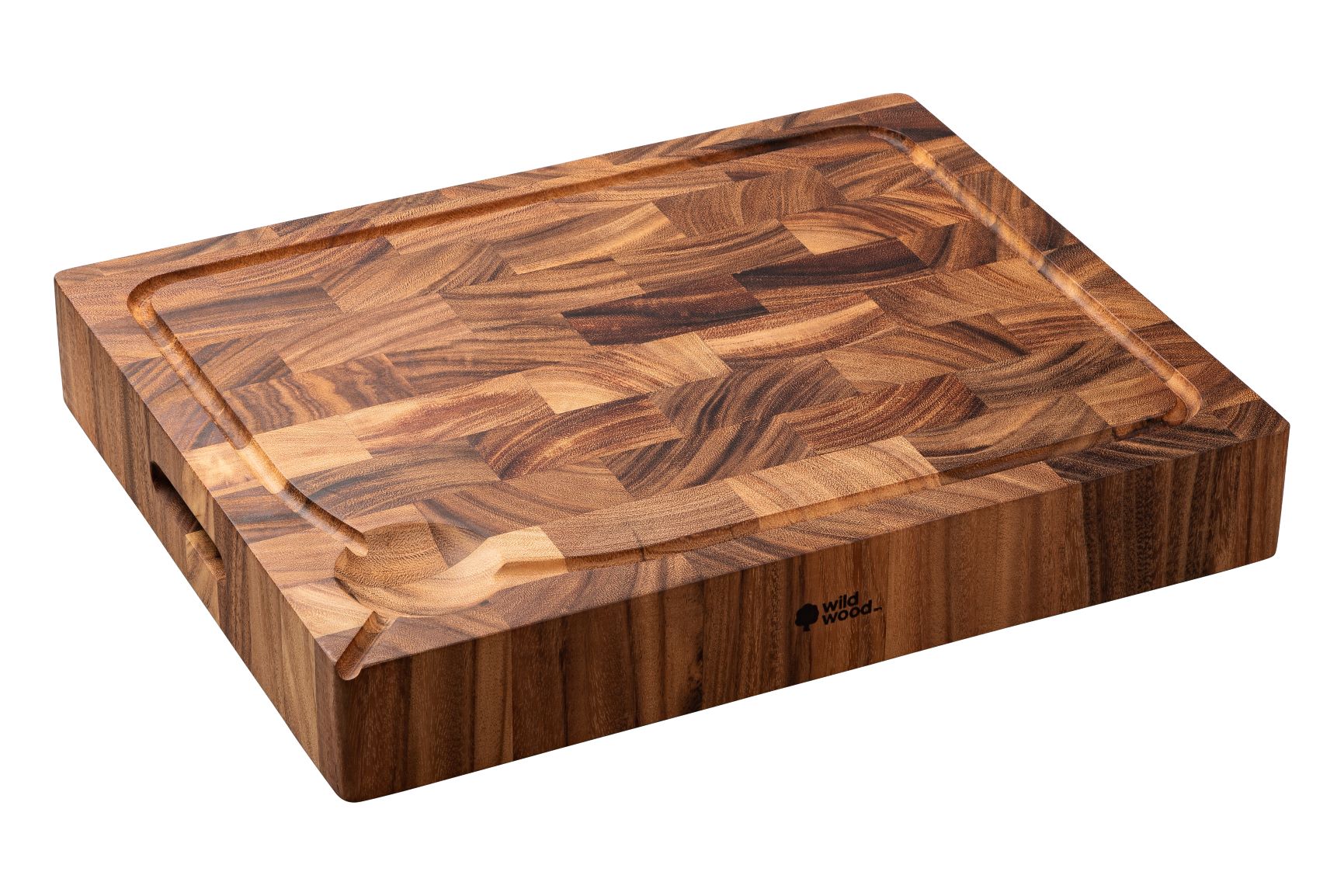
Our most popular butchers block seller is the WCB103 Franklin Large Thick Butchers Block Board. It has plenty of workspace at 50 x 35cm, and with the 7.5cm thickness, made with superb quality end grain Acacia, it is made for the serious home chef.
If you are looking for a lower cost butchers block board then our WCB110 Mogo Chop XL Butchers Block chopping board is also ideal. At 51 x 38cm it has a broader surface area (great for prepping Asian dishes), and the 5.5cm thickness gives it toughness without being too heavy. They are both beautiful boards, and ones you will treasure for a lifetime.